Throw It on the Carrie Furnace! The Pittsburgh Steak Story Nobody Can Prove

Order a steak charred black on the outside and cool red in the middle and half the country will call it Pittsburgh rare. The origin story everyone tells has never been documented, and the name is a bigger deal outside the region than in it.
Say you are from Pittsburgh at a steakhouse in Charlotte or Denver or Dallas and there is a decent chance somebody at the table brings up the steak. Charred nearly black, cool and red at the center, ordered by name. Pittsburgh rare. Pittsburgh style. Black and blue.
The technique is real and the name is genuinely national. Texas Roadhouse will cook one that way if you ask. Food sites publish explainers on it every few months. What none of them have is a source.
Four stories, no documents
There are at least four competing accounts of where the term came from, and they cannot all be true.
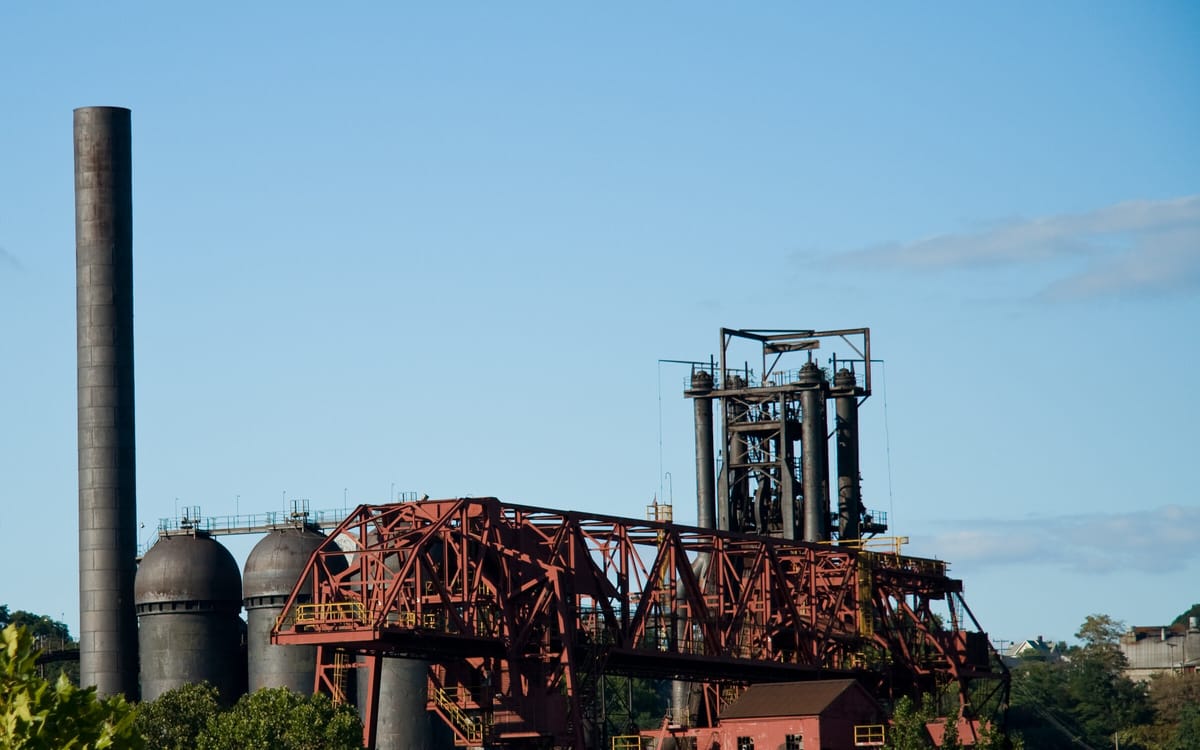
The one everybody repeats involves the mills. Workers had thirty minutes for lunch and heavy jobs that burned through calories, so they brought raw steaks in and cooked them against the blast furnaces, which ran well over 2,000 degrees. The heat was extreme enough to sear the outside in seconds and sterile enough that nobody worried about what the steel had touched. A variation has them using cooling slabs instead, or throwing the meat against the molten steel tubs until it charred and dropped off. Sylvia McCoy of Burgh Bits and Bites has described learning the Carrie Furnace version on a Rivers of Steel tour, where workers were said to "place it against the fiery Carrie Furnace."
The second story has nothing to do with steel. A slaughterhouse during the Depression opened a restaurant in front, where customers picked a cut off a live animal, waited, and were served meat seared briefly to kill bacteria and still at the temperature of the animal it came from.
The third is a mistake that stuck. In 1995 the Post-Gazette's Woodene Merriman recorded the version told at The Colony, a steakhouse that opened here in 1958: a cook accidentally charred a filet nearly black, the waiter covered for the kitchen by telling the customer it was prepared "Pittsburgh" style, and the restaurant went on making them that way for anyone who asked.
The fourth is that somebody did it with a welding torch.
Wikipedia's entry on Pittsburgh rare carries a banner on its origins section noting that it needs additional citations. That banner has been accurate for years. Researchers on the American Dialect Society's mailing list went looking in 2004 and traced the phrase in print back to 1966, which is decades after the mill story would have it starting and eight years after The Colony opened. The barbecue writer Steven Raichlen remembers his mother using the term in the 1950s, which is a memory rather than a record.
None of that disproves the mills. It does mean that a story told as regional history is, at the moment, folklore.
The part that would be easy to check
The steel version has a question sitting inside it that nobody seems to have asked a historian. Blast furnace shells and cooling slabs are not griddles. Whether a mill actually offered a surface at a workable temperature, whether the surfaces were anywhere near clean, and whether there is a single documented instance of a worker doing this are answerable questions. Rivers of Steel runs tours of Carrie Furnace and is the most-cited source for the story, usually secondhand.
There is also the matter of who was buying steak. The Depression and wartime rationing sit directly on top of the years the legend points to.
Bigger outside than in
Here is the strange part for anyone who lives here.
The name is treated nationally as a Pittsburgh signature, invoked in food media the way a cheesesteak is for Philadelphia or deep dish is for Chicago. Locally it is nothing like that prominent. It is not printed on steakhouse menus around here. No Pittsburgh restaurant markets itself on it. It survives, if it survives, as something said out loud between a diner and a server, which means the honest answer about how common it is now can only come from asking the restaurants directly.
What is not in dispute is where the name is doing the most visible work. There is a steakhouse group in the Minneapolis suburbs called Pittsburgh Blue. Its menu explains the steelworker legend to Minnesotans. The name of this city's steel industry is on a building nine hundred miles away, in a metro area that never made steel, selling an origin story that Pittsburgh itself cannot document.
What a name is for
Regions export their food the way they export anything else, which is unevenly and without much control over what happens next. A phrase that may have started as a cook's excuse in a Greentree dining room in 1958, or on a furnace floor in Rankin, or in a slaughterhouse storefront, got picked up, carried out, and turned into shorthand for a whole city's character. Hard, blackened outside. Still red underneath.
That reading is available to anyone, and it is probably why the name traveled while the recipe stayed roughly the same. It is worth noticing that the version of Pittsburgh being sold is the one that stopped existing here around the same time the mills closed.
The steak is still good. The story is still unproven. Both of those can hold at once, and the second one is only going to get settled by somebody local doing the work.
Photo: Jason Pratt via Wikimedia Commons, CC BY 2.0 (cropped)
Sources: Pittsburgh Post-Gazette, "Seven wonders: Longstanding Pittsburgh restaurants that haven't lost their touch," Woodene Merriman, August 27, 1995; American Dialect Society mailing list research on the earliest print citations of "Pittsburgh style," 2004; PA Eats interview with Sylvia Emmenegger McCoy of Burgh Bits and Bites; Wikipedia entry "Pittsburgh rare" and its citation notices; Pittsburgh Blue Steakhouse published menu materials; Rivers of Steel National Heritage Area materials on Carrie Blast Furnace; Barbecue Bible, Steven Raichlen.