Why Everyone Slows Down at the Squirrel Hill Tunnel

Pittsburgh's most cursed commute runs through a 73-year-old machine in the side of a hill. Here is how it works, why it clogs, and why the $138 million fix coming next does not touch the tunnel at all.
It happens on clear days, in light traffic, with no crash and no lane closed. Somewhere around the Edgewood curve, or coming down past the Beechwood Boulevard ramps on the inbound side, the brake lights bloom. The road ahead is open. The tunnel is open. Everyone slows down anyway.
If you drive the Parkway East, you have sat in that slowdown and wondered what the drivers ahead of you are reacting to. The answer involves postwar blasting crews, a hidden second deck that most commuters passed under for sixty years without knowing it, and a quirk of human behavior that the Pennsylvania Department of Transportation has publicly conceded it cannot engineer away.
A hole dug eight feet at a time
The Squirrel Hill Tunnel opened on June 5, 1953, completing the first eight-mile stretch of the Penn-Lincoln Parkway, the road we now call I-376. At $18 million, it was the most expensive single project the state highway department had ever built.
Getting through the hill was slow, loud, and dangerous. Crews worked in shifts around the clock, blasting through rock at roughly eight feet a day, a pace that slowed further after residents living above the bore complained about the shaking. Somewhere around 400,000 cubic yards of rock and earth came out of the hillside, on the order of 40,000 dump truck loads. Three workers were killed during construction.
What they left behind: twin arched concrete tubes, each carrying two lanes in one direction, running 4,225 feet from portal to portal. That is eight tenths of a mile, about a dozen football fields laid end to end, under a living neighborhood.
The machine you drive through
Most drivers never learn this part. For its first six decades, the Squirrel Hill Tunnel had a false ceiling. The flat roof overhead was not the top of the tube. It was a suspended concrete deck, and above it ran a ventilation duct nearly the full length of the tunnel. Fans pulled exhaust up through slots in that ceiling and out of the hill. Traffic moved through the bottom half of the structure the entire time.
The rest of the tunnel works the same way, as equipment wrapped around a road: a lighting plant, a drainage network, a fire-protection system, and eight cross passages connecting the two tubes, each behind a fire door stocked with extinguishers and hose valves for first responders.
Between 2012 and 2014, PennDOT rebuilt most of that machinery in a $49.5 million rehabilitation while more than 100,000 vehicles a day kept driving through it. Crews replaced the electrical and lighting systems, repaired the walls and arched ceiling, retiled, and installed a modern tunnel control system. The most visible change was a subtraction. Engineering studies showed the false ceiling was no longer needed to move air, so out it came, opening up the arch and adding more than a foot of vertical clearance.
That mattered more than it sounds. Before the rebuild, PennDOT was stopping and turning around roughly 40 overheight trucks a month at the portals, many in winter, when snow piled on trailer roofs tripped the height sensors. Every turnaround stalled the traffic behind it for 20 minutes or more.
The slowdown nobody can fix
Which brings us back to those brake lights on a clear day.
The phenomenon is old. Federal highway researchers filmed morning traffic at the tunnel frame by frame in 1961, eight years after it opened, trying to work out why the Parkway East jammed there. By 1957, daily traffic had already reached about 48,000 vehicles. Today the count runs past 100,000, which averages to more than one vehicle entering the corridor every second, around the clock.
Traffic engineers who study tunnels point to sightlines and walls. A portal reads to the brain as a narrowing even when the lanes do not actually narrow, and a wall a few feet from the driver's window makes most people ease off the gas. Some drivers slow out of plain discomfort in a confined, darker space. It only takes a few. On a road running near capacity, each tap of the brakes ripples backward and amplifies, and the resulting wave of stopped traffic can stretch for miles behind a tunnel that is wide open.
PennDOT has said as much publicly for years. During the 2012-2014 rebuild, district officials told reporters that speeding up the tunnel was never the goal, and that if brighter lighting and a taller arch happened to help drivers hold their speed, that would be a welcome side effect. The rebuild made the tube brighter and taller. The morning backup survived it.
What PennDOT is trying next
The next attempt does not touch the tunnel.
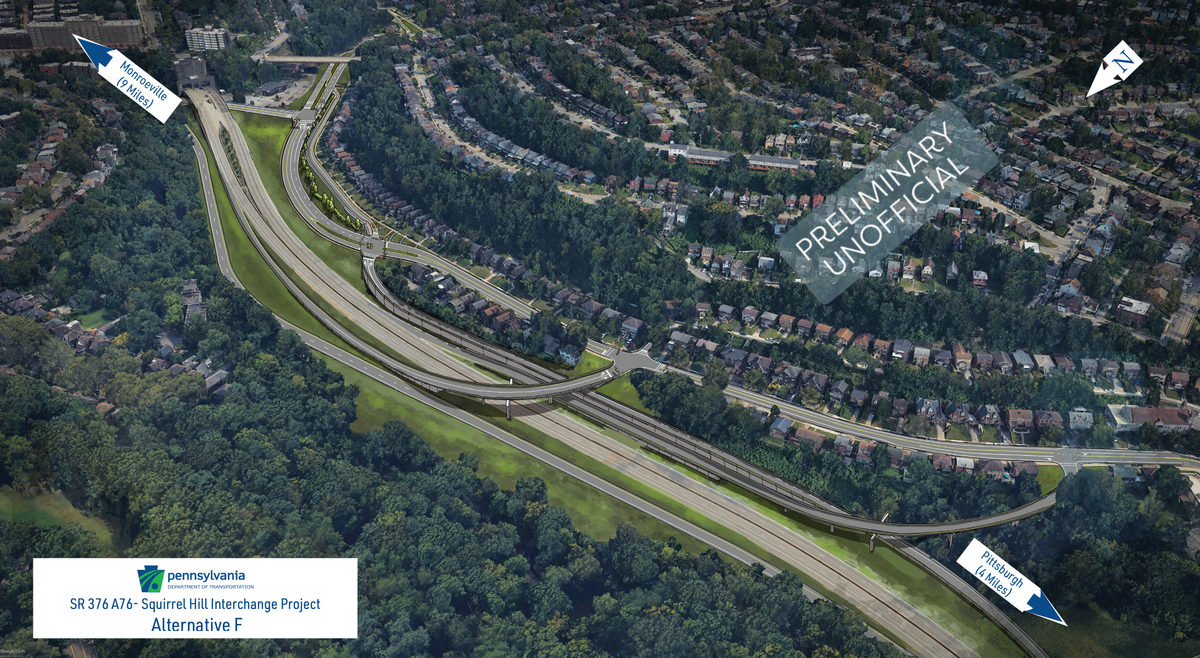
In September 2025, PennDOT District 11 and the Federal Highway Administration named a design called Alternative F as the preferred plan for the Squirrel Hill Interchange Improvement Project, the tangle of ramps on the tunnel's city side where inbound and outbound traffic weaves across itself within sight of the portal. That layout dates to the 1950s and was built for a fraction of today's volume.
Alternative F moves the outbound on-ramp back from the tunnel to give merging traffic more room, and extends the outbound off-ramp so it starts west of the Greenfield Bridge, passes beneath the relocated on-ramp, and ends at a new traffic light on Beechwood Boulevard, eliminating the weave. The inbound off-ramp would split from the highway farther west of the portal, crossing the Parkway on a new bridge. Beechwood Boulevard gets a separate local lane for nearby homes, a roundabout at Monitor Street, and a shared use path along Forward Avenue.
The budget is $138 million. Construction is anticipated to begin in 2029 and finish in 2032, and the design will keep changing through preliminary and final engineering before then.
The tunnel's other approach just got its own overhaul. The bridge carrying the Parkway East over Commercial Street, on the far side of the hill, was replaced this summer in a single accelerated closure after crews spent two years building its replacement alongside the highway.
The hole the East End grew through
Seventy-three years on, the Squirrel Hill Tunnel is easy to treat as an obstacle, the thing standing between you and home. It was built as a connection. When the tubes opened in 1953, they linked downtown to the eastern suburbs at highway speed for the first time, and the region rearranged itself around that fact within a generation. The Parkway East corridor, the postwar growth in Monroeville and the eastern boroughs, the daily commute that tens of thousands of households organize their mornings around: all of it runs through two arches punched into a hill by men advancing eight feet a day.
By 2032, if the schedule holds, the ramps outside the portals will be new. The lighting, the ventilation, the control system, and the ceiling have already been rebuilt once. The walls will stay where they are, four feet off the right shoulder, and drivers will keep easing off the gas when they see them.
Photo: Pennsylvania Department of Transportation.
Sources: Pennsylvania Department of Transportation, I-376 Parkway East Squirrel Hill Interchange Project page and the September 3, 2025 announcement naming "Alternative F" the preferred design; PennDOT District 11 releases on the 2012-2014 Squirrel Hill Tunnel rehabilitation; Highway Research Board Bulletin 324, Squirrel Hill Tunnel Operations Study (1961); Pittsburgh Post-Gazette archives; Detre Library and Archives, Senator John Heinz History Center.