How Pittsburgh Replaced an Interstate Bridge in Less Than a Month

The Parkway East project that should have taken four years was promised in 25 days. It took 17. Here's how PennDOT pulled it off.
If you drove the Parkway East earlier this month, you already know something unusual was happening. On July 10, PennDOT shut down Interstate 376 entirely between the Squirrel Hill Tunnel and the Edgewood/Swissvale interchange, rerouting one of the busiest stretches of highway in western Pennsylvania. Roughly 100,000 vehicles cross that corridor every single day.
A full interstate closure is the kind of thing that usually signals years of orange barrels ahead. Instead, drivers were told to expect something almost unheard of: the road would be back open in 25 days, with a brand-new bridge underneath them.
That promise raised eyebrows. Bridge replacements on this scale typically mean four years of lane restrictions, traffic shifts, and white-knuckle merges. So how do you compress four years of misery into less than a month?
The answer had been hiding in plain sight, sitting just a few feet from the highway, for the better part of two years.
The bridge next door
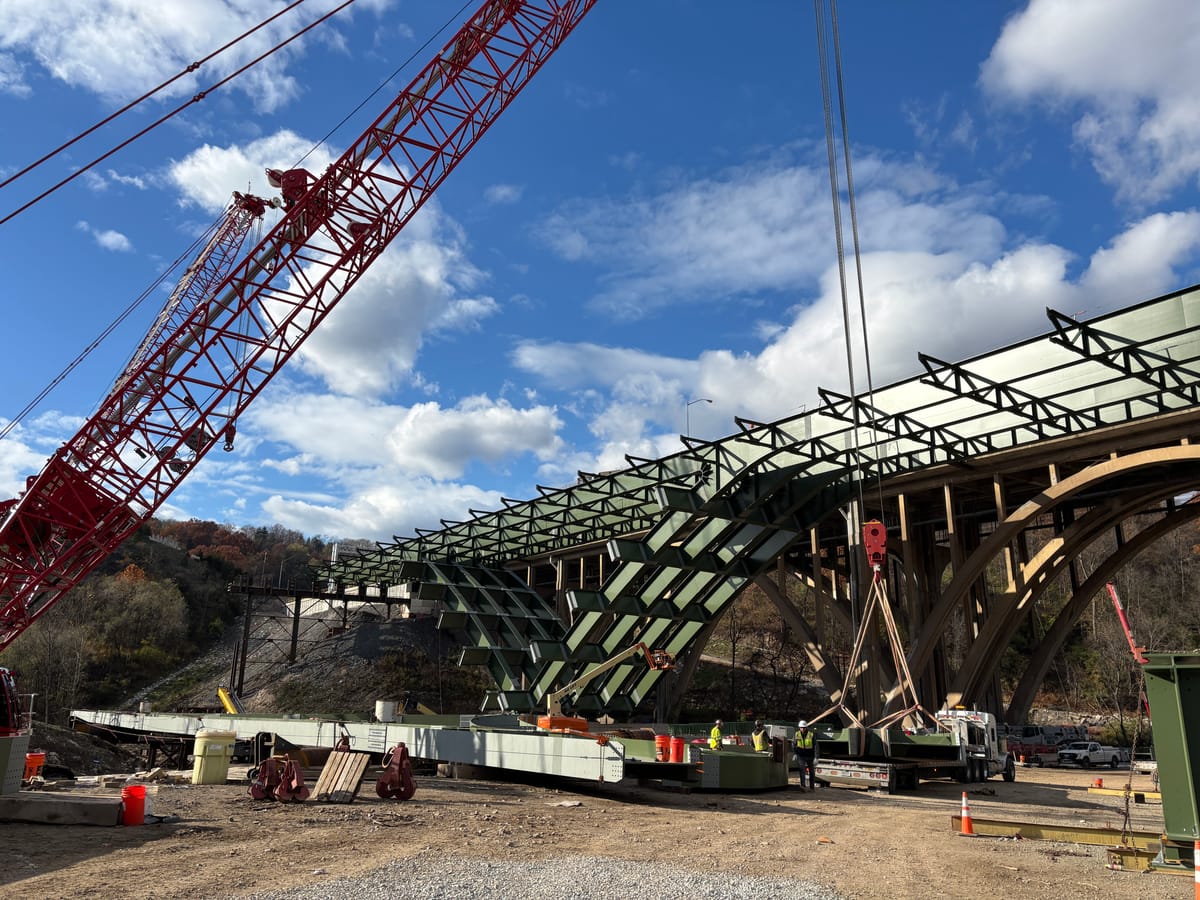
Since June 2024, crews with contractor Fay, S&B USA Construction have been building the new Commercial Street Bridge directly beside the old one, on temporary foundations, while traffic continued rolling across the original 1959 structure. Most commuters barely noticed. The steel delta frames were fabricated in Wisconsin, shipped to Pittsburgh in sections, and assembled on site above Frick Park and Nine Mile Run.
The finished product is a monster: an arched delta-frame span roughly 850 feet long, weighing more than 22 million pounds, built with over 7 million pounds of structural steel and nearly 12,000 cubic yards of concrete.
Which left one obvious problem. The new bridge was in the wrong place. And the old bridge was still standing exactly where the new one needed to go.
First, the boom
Step one was making room. On the morning of July 16, after months of preparation and a one-day weather delay, crews brought down the original 67-year-old bridge in a controlled implosion. Residents nearby were warned about the noise and dust; the demolition went off without incident, and workers spent the following days clearing debris from the valley below.
That set the stage for the part of the project engineers had been planning around from the beginning, and the reason a four-year job could fit inside a 25-day window.
Then, the slide
On Sunday morning, July 19, the new bridge started moving.
Using a technique called Accelerated Bridge Construction, crews raised the 11,000-ton structure about 10 inches on hydraulic jacks and began sliding it sideways along a skidding system toward the interstate's alignment. The span traveled 96 feet in about seven hours, with engineers monitoring every inch of movement to make sure nothing shifted out of tolerance. The final six feet were completed Monday morning.
At 102 feet, PennDOT says it ranks among the largest lateral bridge slides ever performed in Pennsylvania. Transportation Secretary Mike Carroll went further, describing the effort as an immaculate piece of construction.
Why it matters beyond Pittsburgh
The math behind the method is what makes it remarkable. By building the replacement off to the side and sliding it into place during a single closure, PennDOT estimates it eliminated roughly four years of lane restrictions that conventional staged construction would have required. Instead of squeezing 100,000 daily vehicles onto half a bridge for the rest of the decade, the region absorbed one painful but short detour.
With the slide complete, the remaining work was less dramatic but relentless: anchor bolts, expansion joints, paving, barriers, utility connections, pavement markings, and final inspections, with crews working around the clock. It paid off ahead of even the optimistic timeline. On Monday evening, July 27, traffic rolled across the new bridge in both directions, 17 days after the interstate closed and a full week ahead of the August 3 target. The 25-day promise turned out to be conservative.
The early finish was not an accident of luck. The contract offered up to $2 million in incentives for reopening before July 28 and carried penalties for slipping past the deadline, and state officials said the project still came in under budget, with no recordable injuries among the hundreds of workers on site. Gov. Josh Shapiro, announcing the reopening from the bridge deck, called the slide the largest known structure ever moved into place this way in the United States.
Not everything reopened Monday. Commercial Street itself, the local road beneath the bridge, remains closed into early August, the Nine Mile Run Trail will follow after that, and demolition cleanup in the valley below will continue into next year. The overall $95 million project won't fully wrap until summer 2027, with approach work and site restoration still ahead. But the hard part, the part that closed an interstate and moved 22 million pounds of steel sideways, is done.
Four years of construction traffic, condensed into 17 days. For once, the shortcut actually worked.
Sources: PennDOT project announcements and Commercial Street Bridge project records, the Pennsylvania Governor's Office, and reporting from WESA, WPXI, and CBS Pittsburgh