The $1.6 Billion Megaproject Hiding in Plain Sight on the Ohio River

Pennsylvania's largest single infrastructure investment isn't in Philadelphia or Pittsburgh. It's in Monaca, and most of Beaver County drives past it without a second look.
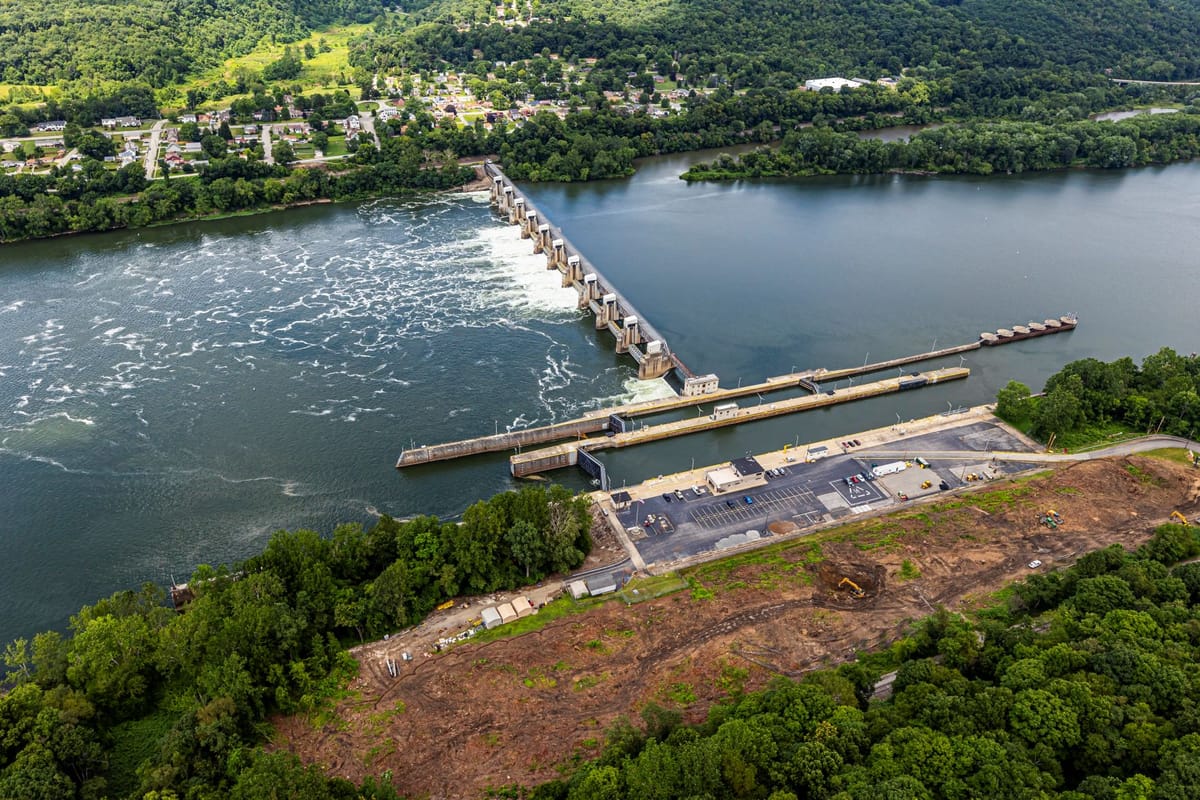
If you've crossed the Ohio River anywhere near Monaca lately, you've driven within sight of the biggest single federal infrastructure investment in Pennsylvania. There were no detours, no implosions on the morning news, no viral videos. Just a cluster of cranes, barges, and a brand-new concrete plant rising on the riverbank at a facility most people couldn't name.
It's the Montgomery Locks and Dam, and the roughly $1.6 billion rebuild underway there will take until 2033 to finish. To understand why the federal government is spending that kind of money in Beaver County, you have to understand a problem that has been quietly getting worse since Franklin Roosevelt's first term.
The oldest, smallest doors on the river
Montgomery opened in 1936. Along with its siblings upstream at Emsworth and Dashields, it forms the first set of locks and dams on the Ohio River below the Point in Pittsburgh, and the three of them hold an unwanted distinction: the oldest and smallest lock chambers operating anywhere on the entire Ohio River system.
The locks work like a water elevator. The dam holds the river at a navigable depth, and the lock chambers raise or lower boats between the pools on either side. Roughly 12 to 20 million tons of goods pass through this stretch every year: coal, fuel, road salt, steel materials, the raw ingredients of the regional economy, worth more than $2 billion in total.
Here's the bottleneck. Montgomery's main chamber is 600 feet long and 110 feet wide, big enough to swallow a standard nine-barge tow in one pass. Its backup chamber, the one that takes over whenever the main chamber needs maintenance, is 360 feet by 56 feet. That's big enough for one barge at a time. A tow that clears the main chamber in a single cycle had to be broken apart and pushed through the small chamber piece by piece, a process that could take nine hours or more per tow. One nine-barge tow carries the equivalent of about 1,500 trucks. Now imagine parking that convoy at a door that admits one truck per cycle.
And the stakes of doing nothing are bigger than slow barges. The Army Corps of Engineers has estimated that a one-year closure at Montgomery would cost the U.S. economy nearly $180 million and push some 400,000 additional truck trips onto the region's highways.
Building a new chamber without closing the river
The fix sounds simple and is anything but: demolish the undersized backup chamber and build a second full-size one, 600 feet by 110 feet, in its footprint, all while the main chamber stays open and the barges keep moving. The Army Corps' Pittsburgh District compares it to rebuilding half of a working facility without ever hanging a closed sign.
The project hit its stride over the past year. The small auxiliary chamber closed for good in March 2025, and joint-venture contractor Trumbull-Brayman began tearing it out, working from excavator barges in the river. Crews assembled field offices, paved access roads, and built something unusual on site: a full concrete batch plant, positioned to produce the roughly 400,000 cubic yards of concrete the new chamber will consume, without a single mixer truck idling on Route 18.
The Corps also awarded a $35 million contract for fabricating the new chamber's hydraulic steel, including the massive miter gates, the angled steel doors that hold back the river at each end of the lock. The next phases call for a new middle wall and a cofferdam, the temporary watertight barrier that will let crews pour concrete in dry conditions in the middle of a flowing river.
"The hard work this year has set the stage for us to place copious amounts of high-quality concrete starting in the spring," project manager Chris Dening said as the site transitioned from setup to full production.
What Beaver County gets out of it
Montgomery is the anchor of the larger Upper Ohio Navigation Project, a multibillion-dollar effort to modernize all three of the aging locks below Pittsburgh. The Corps projects the Montgomery work alone will support more than 13,000 jobs during construction, with the full project supporting over 28,000 across its lifetime and about 5,300 permanent jobs once the new chambers are in service.
For nearly a century, the dam at Monaca has been doing an invisible job: keeping the Ohio deep enough, reliable enough, and cheap enough that the region's heaviest industries never had to think about it. The next seven years of cranes and concrete are the price of not thinking about it for a century more.
Photo: U.S. Army Corps of Engineers, Pittsburgh District. Sources: U.S. Army Corps of Engineers Pittsburgh District, Waterways Journal, Engineering News-Record.